

About This Book
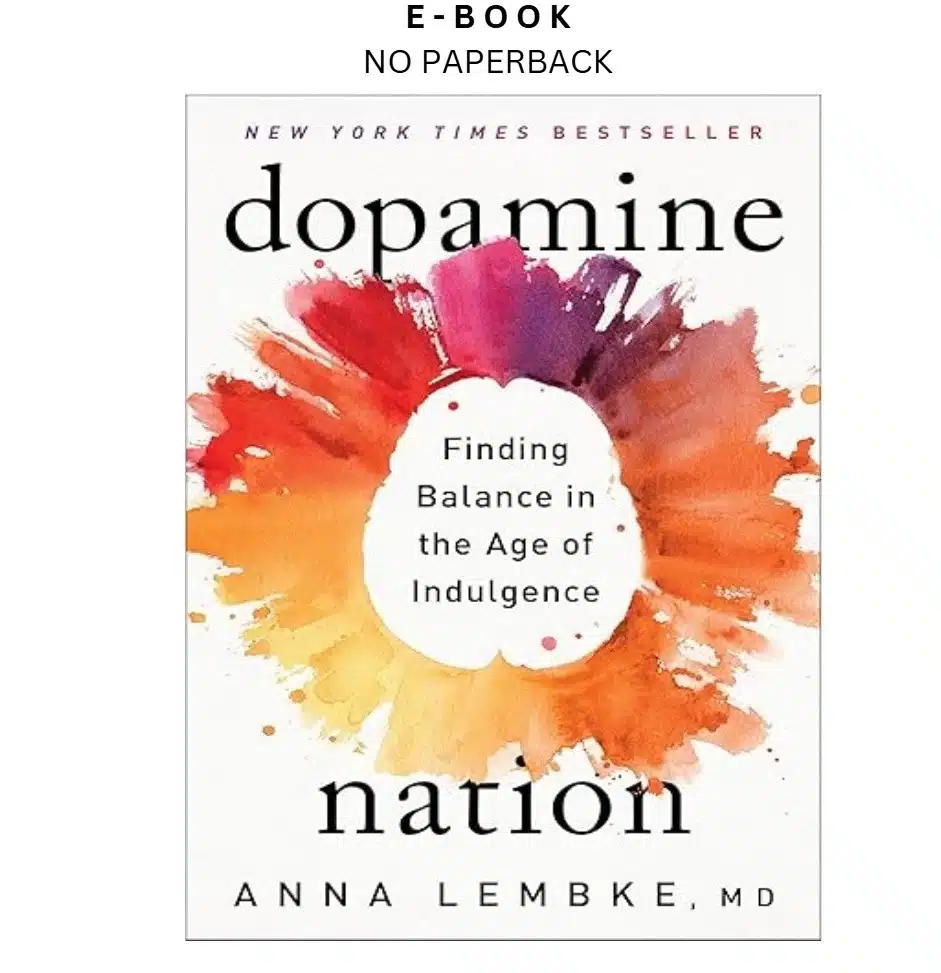
Dopamine Nation examines why constant access to pleasure, through drugs, food, social media, shopping, and endless streaming, is making modern life harder rather than easier, and what to do about it. Dr. Anna Lembke, a psychiatrist and Stanford professor who chairs the university’s Addiction Medicine Dual Diagnosis Clinic, draws on both clinical case studies and her own struggle with compulsive romance-novel reading to explain how the brain’s pleasure and pain systems work as a single balance scale. The book became a Los Angeles Times and New York Times bestseller for translating addiction neuroscience into a framework anyone can use, whether the drug in question is a substance or a habit like scrolling.
Main Ideas and Insights
Lembke’s central idea is that pleasure and pain are processed in the same region of the brain and function like opposite ends of a scale: every dopamine hit that tips the balance toward pleasure is met by an equal, delayed tilt back toward pain, which is why overconsumption of anything eventually leaves people feeling worse, not better. The book is organized in three parts: it opens by explaining why constant access to high-dopamine stimuli has made compulsive overconsumption a shared modern problem, moves into self-binding strategies (physical, chronological, and categorical ways of limiting access to a trigger before willpower is needed), and closes by arguing that deliberately seeking out mild discomfort, cold exposure, hard exercise, honest conversations, can help reset an overloaded reward system.
Who Should Read This Book
This book suits anyone who has noticed their relationship with a phone, food, shopping, or another habitual pleasure has stopped feeling good and started feeling compulsive, as well as therapists, educators, and parents looking to understand the neuroscience behind modern overconsumption. No clinical background is needed; Lembke translates the science through patient stories rather than jargon.
Putting the Ideas into Practice
Lembke’s most concrete tool is a 30-day dopamine fast, structured around the acronym DOPAMINE (Data, Objective, Problems, Abstinence, Mindfulness, Insight, Next step, Experiment), used to reset tolerance to a specific habit or substance. For triggers that can’t be fully removed from daily life, like food or a smartphone, she outlines self-binding strategies instead: physical barriers, time-based restrictions, or category-based rules that reduce access without requiring constant willpower.
About This PDF Edition
Dopamine Nation is available from LD Global as a DRM-free PDF, giving readers immediate, permanent access to the full text on any device they choose to read it on. Because Lembke’s book combines scientific explanation with patient case studies, many readers find it useful to highlight passages and return to specific chapters, something the searchable, annotatable PDF format supports well. The file opens on a laptop, tablet, phone, or e-reader, and works with any standard PDF app, including Adobe Acrobat, Apple Books, or the Kindle app via file transfer. Once purchased from LD Global, the file is owned permanently, with no subscription fees and no restriction on how many devices it’s transferred to.
You May Also Like
Readers who enjoyed Dopamine Nation also browsed It’s Not You: Identifying and Healing from Narcissistic People, another psychology-based guide available as an instant PDF download from LD Global.